OFF-ROAD · BUYING GUIDE · RESEARCH-BASED
The short answer
Electric dirt bikes are quiet, torquey, and far cheaper to run than gas, which is why they have taken over trail riding. But before you look at a single spec, answer one question: where will you legally ride it? Most of these machines are off-road only and not street legal, and the ones that look like e-bikes often are not e-bikes in the eyes of your state. Get that wrong and you own a very fast machine you cannot legally use.
How we picked. These recommendations come from research, not from us riding every machine. We compared published specifications, safety and certification information, and the weight of expert testing and long-term owner reviews. We have not personally ridden every bike here, and we say so plainly. Nothing on this page is legal advice. Rules vary enormously by state and even by trail, and it is your responsibility to check yours.
Before you buy: most electric dirt bikes are not street legal, and which category yours falls into changes where you can legally ride it. The three legal categories are explained in the next section, and it is worth reading before you spend anything.
Disclosure: Sustainable Transportation is reader-supported. When you buy through links on this page, we may earn an affiliate commission at no extra cost to you. A commission never buys a better ranking. See our affiliate disclosure.
Start here: the three legal categories
This is the part almost every buying guide skips, and it is the part that determines whether your purchase is usable. In most US states a two-wheeler falls into one of three buckets.
1. Electric bicycle (Class 1, 2, or 3)
Has functional pedals, motor assistance capped at 20 or 28 mph, and generally limited motor power. Treated like a bicycle: no licence, no registration, no insurance in most states, and allowed in bike lanes.
Machines marketed as “electric dirt bikes” almost never qualify, because they exceed the speed or power limits, and many have no working pedals at all. See our e-bike classes explainer for how those rules work.
2. Off-highway vehicle (OHV), off-road use only
Where most true electric dirt bikes land. Legal on private land with permission, and on designated OHV trails and parks, which frequently require an OHV registration sticker and sometimes a trail permit. Not legal on public roads, sidewalks, or bike paths.
The practical question this raises, and the one worth answering before you buy: do you have somewhere to ride, and how will you transport the bike there? These machines are heavy, so a rack or trailer is part of the real cost.
3. Motorcycle or moped
Some higher-powered machines are classed as motorcycles or mopeds, which means registration, a licence endorsement, insurance, and equipment such as mirrors, a horn, and DOT-approved lighting. A few models are sold in street-legal trim for exactly this reason.
The trap to avoid: a bike sold as “street legal” in one state may not be registrable in yours. Before buying, check with your state DMV whether that specific model can be titled and registered, because a machine you cannot register is one you cannot legally ride on the road, whatever the listing says.
What actually matters when choosing
Power, and being honest about your skill
Electric motors deliver full torque instantly, with no clutch and no gears to manage. That makes them easy to ride slowly and very easy to ride too fast. A machine putting out several kilowatts accelerates harder than most people expect, and the absence of engine noise removes the audible cue riders normally use to judge speed.
If this is your first powered two-wheeler, buy less power than you think you want, and look for models with selectable power modes so the bike can grow with you.
Range is measured differently here
Claimed range on a dirt bike is even more optimistic than on an e-bike, because aggressive riding uses power at a completely different rate than steady cruising. Hard trail riding can cut range dramatically compared with the headline figure.
Think in ride time rather than miles. Ask what owners actually get on trails, not what the specification sheet claims, and remember there is no pushing one of these home.
Weight, transport, and charging
These are heavy. That affects how you get the bike to the trail, whether you can lift it alone after a fall, and how you store it. A hitch rack rated for the weight, or a small trailer, is a real line item.
Check whether the battery is removable, because a removable pack means charging indoors rather than running a cable to a shed. Large lithium batteries should be charged where a fault would not be catastrophic, and never left charging unattended overnight in a living space.
Parts, support, and the cheap-import problem
This category is full of unbranded machines at tempting prices. The risk is not usually that the bike arrives broken, it is that in eighteen months you need a controller, a battery, or a specific bearing and there is no supply chain and no support. Established brands cost more and are worth it here.
Safety gear is not optional on these
A bicycle helmet is not adequate for a machine doing 40+ mph off-road. Riders in this category should wear a full-face motocross or DOT-rated helmet, plus goggles, gloves, boots over the ankle, and ideally knee protection and a chest protector.
If you are coming from cycling rather than motorcycling, this is the biggest adjustment to make, and the cheapest mistake to avoid. Budget for gear as part of the purchase, not as an afterthought. Our commuter gear guide covers bicycle-speed equipment; this category needs a step up from all of it.
Our picks
Five bikes, ranked. We weight three things above top speed: whether a third-party safety certification is actually named, how much owner feedback exists, and whether the power level suits a real rider rather than a spec sheet. Power is the easiest thing to buy here and the easiest to get wrong.
Read this before you order. These are not e-bikes. Most fall outside the electric bicycle classes entirely, which means where you can legally ride them, and whether you need a licence, plate, or minimum age, is decided by your state and not by the seller. The legal categories are explained further down this page.
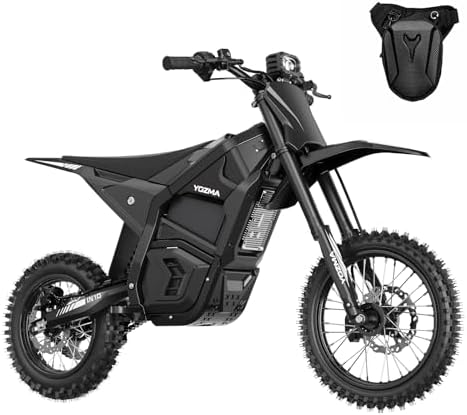
1. Best Overall and Most Proven: Yozma IN10

Who it is for: the rider who wants a real electric dirt bike without jumping straight to 55 mph, and who would rather buy something hundreds of people have already ridden.
- Battery certification: removable UL-certified 48V 23Ah pack, roughly 1,104Wh
- Motor: 2600W peak mid-drive
- Top speed: 40 mph
- Claimed range: up to 53 miles
- Climbing: slopes up to 30 degrees
- Suspension: 220mm travel front hydraulic fork, rear nitrogen shock
- Braking: hydraulic discs with EABS regenerative assist
- Manufacturer minimum age: 16
- Owner rating: 4.1 stars from 213 ratings, checked August 2026
Why it earned this spot: 213 owner ratings is roughly seven times what anything else here has, and it is the only bike in this guide that states a UL-certified battery. On a machine you charge in a garage attached to your house, that matters more than another 1000 watts. The 2600W mid-drive is also the most sensible power figure here for anyone who is not already an experienced motocross rider.
The honest con: 2600W is the least powerful bike in this guide. If you are an experienced rider looking for something that keeps pulling past 40 mph, this will feel tame, and the ESKUTE RT-X or the R6000 are the honest answers. None of these are street-legal e-bikes. At these speeds you are looking at off-highway or motorcycle territory in most states, so check your local age, licence, registration, and helmet rules before you buy, not after.
Skip it if: you already ride motocross and want maximum power. This is the sensible bike, not the fastest one.
2. Most Power for the Money: COSWHEEL R6000

Who it is for: an experienced rider who wants serious speed and range and is not paying a premium brand for it.
- Certification: the listing does not state UL or TUV certification
- Motor: 7000W peak
- Battery: 60V 30Ah, roughly 1,800Wh
- Top speed: 55 mph
- Tires: 17 inch dirt
- Suspension: front and rear
- Braking: hydraulic discs
- Gearing: 7-speed
- In the box: tool kit, fenders, charger, manual
- Owner rating: 4.4 stars from 29 ratings, checked August 2026
Why it earned this spot: 7000W peak and a 1,800Wh battery for this money is the most raw capability per dollar in the guide, and 4.4 stars across 29 ratings is the highest rating of any bike here with a meaningful sample. The 7-speed drivetrain is unusual too, and genuinely useful if you also pedal it on trails.
The honest con: 55 mph on dirt is a serious machine, and the listing states no third-party safety certification at all, neither UL nor TUV. Those two facts together mean this is a bike for someone who already knows what they are doing and who will not charge it inside a living space. None of these are street-legal e-bikes. At these speeds you are looking at off-highway or motorcycle territory in most states, so check your local age, licence, registration, and helmet rules before you buy, not after.
Skip it if: this is your first powered off-road vehicle, or you charge indoors. Both point to the Yozma.
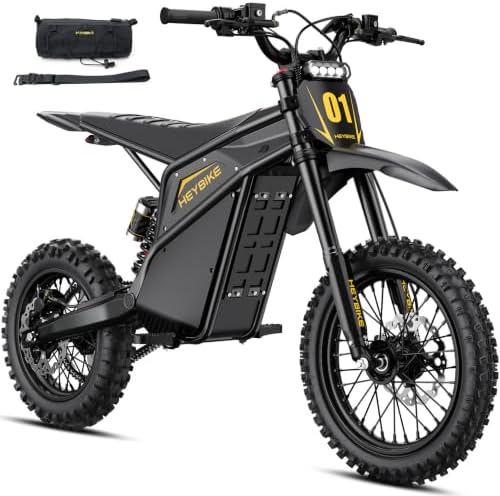
3. Best Fit Range and Only One With Reverse: Heybike Raven

Who it is for: households where more than one person rides, and anyone who has ever had to walk a heavy bike backwards out of a tight spot.
- Certification: BMS battery management stated, but no UL or TUV certification named
- Motor: 4160W peak mid-drive, 190Nm torque
- Battery: 52V 26Ah, roughly 1,352Wh
- Top speed: 45 mph
- Claimed range: up to 50 miles
- Tires: 14 inch fat
- Suspension: hydraulic front fork, rear nitrogen shock
- Braking: heavy-duty hydraulic discs
- Seat height: 29.5 inches, fits riders roughly 3 ft 11 in to 6 ft 1 in
- Special feature: reverse gear
- Owner rating: 4.2 stars from 30 ratings, checked August 2026
Why it earned this spot: two practical features nothing else here offers. The fit range genuinely spans a teenager and a tall adult, which matters if the bike is shared. And the reverse gear sounds like a gimmick until you have tried to back a 150 lb bike out of a trailer or up a slope on your own.
The honest con: 14 inch wheels are small for genuine off-road work. They handle fire roads and trails but get deflected by ruts and rocks that 17 or 19 inch wheels roll through. The listing also names no third-party certification, only its own BMS. None of these are street-legal e-bikes. At these speeds you are looking at off-highway or motorcycle territory in most states, so check your local age, licence, registration, and helmet rules before you buy, not after.
Skip it if: you ride rocky or rutted terrain. Wheel size is the limitation, and no amount of power fixes it.
4. Longest Range and Most Power: ESKUTE RT-X 19″/17″

Who it is for: a rider who wants full-size motocross geometry and a battery big enough for a whole day out.
- Certification: TUV certified, stated in the listing
- Motor: 6500W peak brushless mid-drive
- Battery: 72V 30Ah removable, roughly 2,160Wh, automotive-grade cells
- Top speed: 53+ mph
- Claimed range: up to 70 miles
- Wheels: 19 inch front, 17 inch rear
- Suspension: dual hydraulic with tunable compression and rebound
- Assembly: 90 percent pre-assembled, about 30 minutes
- Owner rating: 5.0 stars from 1 rating, checked August 2026
Why it earned this spot: the 19 inch front and 17 inch rear combination is proper dirt bike geometry, not an oversized bicycle, and it changes how the bike handles ruts and jumps. A 2,160Wh battery is also the largest here by a wide margin, and the suspension is the only one in this guide with tunable compression and rebound.
The honest con: one owner rating. A single 5-star review tells you essentially nothing, and we would rather say that than let the number flatter the bike. TUV certification is real and worth having, but it is not the same as a long service record.
Skip it if: you want evidence rather than specifications. The Yozma has 213 ratings; this has one. None of these are street-legal e-bikes. At these speeds you are looking at off-highway or motorcycle territory in most states, so check your local age, licence, registration, and helmet rules before you buy, not after.
5. Also Worth Comparing: ESKUTE Mid-Drive 3500W

Who it is for: a rider who wants ESKUTE build and TUV certification at a lower power tier than the RT-X.
- Certification: TUV certified, stated in the listing
- Motor: 3500W peak mid-drive, 220Nm torque
- Battery: 48V 23Ah, roughly 1,104Wh, 6-hour charge
- Top speed: 38 to 46 mph
- Claimed range: 53 miles
- Climbing: 35 degree off-road climbs
- Suspension: nitrogen-filled, resists cavitation over long rough sessions
- Frame: reinforced steel, 265 lb rider limit
- Warranty: 1 year, US-based support and parts
- Owner rating: 4.3 stars from 1 rating, checked August 2026
Why it earned this spot: 220Nm of torque at 3500W is a better balance for trail riding than raw top speed, and the nitrogen-filled shocks are specified to keep working after hours of hard use rather than fading. US-based parts and support is also worth more than it sounds on a machine that will eventually need something replaced.
The honest con: like the RT-X, it has a single owner rating, so there is no reliability picture yet. The 265 lb rider limit is also lower than it first appears once you add gear and a backpack. None of these are street-legal e-bikes. At these speeds you are looking at off-highway or motorcycle territory in most states, so check your local age, licence, registration, and helmet rules before you buy, not after.
Skip it if: you want a proven bike. On the evidence available, the Yozma is the safer purchase.
Who this is NOT for
- Anyone without legal riding access. If you have no private land and no OHV trails nearby, you are buying something you cannot use. Solve this first.
- Commuters. If the goal is replacing car trips, an e-bike is legal in more places, cheaper, and far easier to park and store.
- Anyone hoping to ride it on bike paths. These are not bicycles, and riding them on shared paths is both illegal in most places and the fastest way to get e-bikes banned from those paths for everyone.
- First-time riders buying on power alone. Instant torque plus no engine noise is a genuinely different skill.
- Anyone without somewhere safe to charge and store a large lithium battery.
Frequently asked questions
Are electric dirt bikes street legal?
Most are not. The majority are sold as off-highway vehicles for use on private land and designated OHV trails. Some models are offered in street-legal trim, and some states allow registration as a moped or motorcycle, but this varies enormously. Check with your state DMV whether the specific model can be titled and registered before you buy, rather than relying on a product listing.
Do I need a licence or insurance?
For off-road use on private land, usually neither, though many public OHV areas require registration and a trail permit. If the machine is classed as a motorcycle or moped for road use, then yes: licence, registration, and insurance all apply. This is decided by your state, not by the manufacturer.
How is this different from a Class 3 e-bike?
A Class 3 e-bike has working pedals, assists only while you pedal, and cuts out at 28 mph, which keeps it legally a bicycle. Electric dirt bikes typically have far more power, higher top speeds, and often no functional pedals, which puts them in the off-highway or motorcycle category instead. The visual similarity between the two is exactly why people get caught out.
Are they cheaper to run than gas dirt bikes?
Yes, substantially. No fuel, no oil changes, no air filters, no spark plugs, and far less routine maintenance. The main long-term cost is the battery. They are also near-silent, which in practice means more places tolerate them and you can ride earlier and later without annoying neighbours.
The picks side by side
Here are the picks together, with live prices pulled from Amazon. The reasoning behind each one is in the write-ups above, and none of these positions were paid for.


Sources
- US Consumer Product Safety Commission — Micromobility: e-bikes, e-scooters and hoverboards, for battery fire risk, charging guidance and the case for certified equipment.
Checked September 2026. Regulations and published figures change; verify the current source before acting on anything here.