MOBILITY · BUYING GUIDE · RESEARCH-BASED
The short answer
The first decision is not brand, it is wheels. A 4-wheel scooter is more stable and better outdoors on uneven ground. A 3-wheel turns more tightly and suits indoor use and tight spaces. After that, the specification that matters most is not range or speed, it is whether the scooter physically fits your life: your doorways, your kerbs, and your car boot if it has to travel.
Before you buy: a mobility scooter is a medical mobility device, and the wrong one is a genuine fall risk. We strongly recommend an assessment by a doctor, physical therapist, or occupational therapist first. The full guidance is in Please read this, at the end of this page.
Disclosure: Sustainable Transportation is reader-supported. When you buy through links on this page, we may earn an affiliate commission at no extra cost to you. A commission never buys a better ranking. See our affiliate disclosure.
3 wheels or 4? The decision that shapes everything
Three wheels give a much tighter turning circle. That matters enormously indoors, in shops, around furniture, and in narrow hallways. The trade-off is stability: with one wheel at the front, a 3-wheel scooter is easier to tip on a slope or a camber, so it is best on flat, even surfaces.
Four wheels are far more stable, which is what you want on grass, gravel, kerbs, and sloped pavements. The cost is a wider turning circle, so they are harder work indoors and in tight aisles.
The simple rule: mostly indoors and on smooth flat ground, choose 3 wheels. Outdoors, uneven pavements, any slopes, choose 4. If the honest answer is both, prioritise stability, because a tip on a kerb is a far worse outcome than a three-point turn in a supermarket aisle.
Measure before you buy, not after
This is where most regret comes from. Get a tape measure and write these down before ordering anything.
- Weight capacity. Check the rider’s weight plus anything routinely carried. Do not buy to the limit; leave headroom, because exceeding capacity wrecks range, braking, and stability.
- Doorway widths at home and anywhere visited regularly, compared against the scooter’s overall width.
- Turning circle versus your hallway and the tightest room the scooter needs to enter.
- Seat width and height, so transfers on and off are safe and comfortable.
- Ground clearance, if there are kerbs, thresholds, or uneven paths on the daily route.
- Heaviest single piece when disassembled, if it must go in a car. This is the number that decides whether a “portable” scooter is portable for you, and it is often 30 to 40 pounds or more.
Range, and why the number is optimistic
Quoted range assumes a light rider, flat smooth ground, mild weather, and a new battery. Real-world range is reduced by rider weight, hills, cold, grass or gravel, and battery age. Batteries also lose capacity over the years, so a scooter that comfortably covered a route when new may not after a few winters.
The safe approach: work out the longest regular round trip, then choose a scooter rated for roughly double it. That buffer is not indulgence, it is what stops someone being stranded, which is the outcome that matters most here.
Will insurance or Medicare pay for it?
Possibly, but the honest answer is that it depends, and there is one detail worth knowing before you shop.
Medicare Part B may cover mobility scooters as durable medical equipment when specific medical-necessity criteria are met, which generally involves a doctor’s prescription and often a face-to-face examination, and the equipment usually has to be obtained through a supplier enrolled with Medicare.
What that means practically: a scooter bought from a general online retailer is typically an out-of-pocket purchase, not a reimbursed one. If cost is a barrier, speak to the doctor and to Medicare or your insurer first, because going through an approved supplier may cost you far less than buying retail. We would rather tell you that than sell you a scooter you could have had covered.
Coverage rules change, so verify current requirements directly with Medicare or your plan rather than relying on any article.
Using one safely
- Practise somewhere quiet before using it in traffic or a busy shop. Reversing in particular takes getting used to.
- Approach kerbs and ramps straight on, never at an angle, which is the classic way scooters tip.
- Slow down before turning, especially on a 3-wheel model.
- Check local rules. Where scooters may be used, on pavements, paths, or roads, varies by state and city.
- Add lights and a flag if it is used near traffic. Low-profile vehicles are hard for drivers to see.
- Charge as the manufacturer directs, and do not let the battery sit fully flat for long periods, which shortens its life.
Our picks
Five scooters, ranked. In this category we weight two things above specifications: whether the machine is a listed FDA Class II medical device, and how many owners have actually used it. A mobility scooter is bought once, often by someone who cannot easily return it, so track record counts for more than features.
Speed is not a benefit here. Typical mobility scooters run at 4 to 6 mph, roughly walking pace, and that is deliberate. Where a machine in this list goes significantly faster, we flag it as a risk rather than a selling point.
1. Best Overall: Rascal Venture 3-Wheel

Who it is for: most people buying a first mobility scooter, especially if it needs to travel in a car boot and be reassembled by someone who is not strong.
- Classification: FDA Class II medical device
- Wheels: 3, for the tightest turning circle
- Range: up to 10 miles per charge
- Top speed: 4 mph, roughly a brisk walking pace
- Weight capacity: 300 lb
- Transport: separates into five pieces, heaviest 29.5 lb
- Braking: regenerative and electromechanical
- Comfort: adjustable seat height, armrests, and tiller, swivel seat, front basket
- Owner rating: 4.8 stars from 1,141 ratings, checked August 2026
Why it earned this spot: this is the single best-evidenced product anywhere on this site. 1,141 owners at 4.8 stars is not a marketing number, it is a track record, and nothing else in this category comes close. It is also a genuine FDA Class II medical device rather than a consumer gadget shaped like one, which is the distinction that matters most in this category. The five-piece disassembly with a 29.5 lb heaviest part is what makes it usable in real life: a spouse or adult child can load it into a car without a hoist.
The honest con: 3 wheels turn tighter but are less stable on cambered pavements and rough ground than 4. And at 4 mph with a 10 mile range, this is a scooter for shops, appointments, and neighbourhood distances, not for covering a town.
Skip it if: the main use is outdoors on grass, gravel, or uneven ground. Go to the Conquest for 4 wheels and more range.
2. Best for Outdoors and Rough Ground: Rascal Conquest 4-Wheel

Who it is for: someone who spends real time outdoors, on pavements with camber, park paths, or uneven ground, and who values stability over turning circle.
- Classification: FDA Class II medical device
- Wheels: 4, for stability on uneven and cambered surfaces
- Range: up to 17 miles per charge
- Top speed: 6 mph
- Weight capacity: 350 lb
- Braking: regenerative and electromechanical
- Visibility: rearview mirror and high-intensity LED headlight
- Comfort: adjustable seat height, armrests, tiller, swivel seat, front basket
- Owner rating: 4.4 stars from 82 ratings, checked August 2026
Why it earned this spot: the fourth wheel is the whole point. A cambered pavement, the kind that slopes toward the road, is where 3-wheel scooters feel least secure, and that is most pavements. You also get 70 percent more range than the Venture and a rearview mirror, which is a genuine safety item in crowded places where you cannot turn your body easily.
The honest con: it does not break down for transport the way the Venture does, so you need a vehicle hoist, a ramp, or a van. It also turns in a much wider circle, which is noticeable in shop aisles and at home.
Skip it if: you need to lift it into a car, or you will mostly use it indoors and in shops. The Venture is the better fit.
3. Lightest and Best for Travel: PAISEEC D3
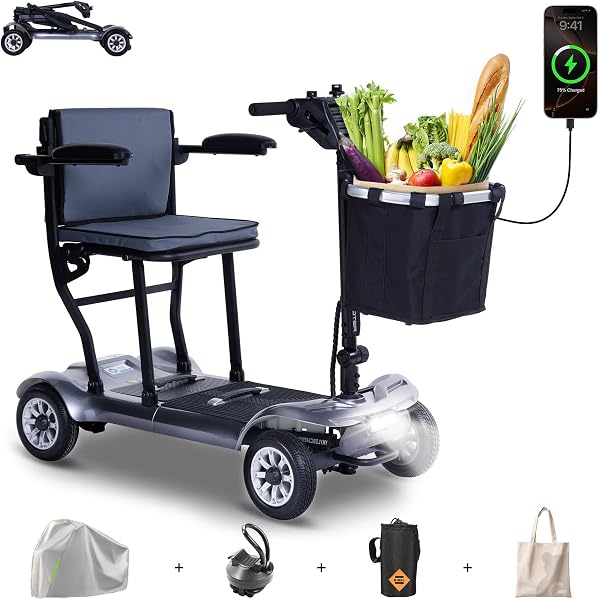
Who it is for: anyone who flies, or who needs a scooter one person can fold and lift without dismantling it.
- Weight: 39.7 lb, aluminium frame
- Folding: 2-step, no tools, folds in seconds
- Batteries: two detachable lithium packs included
- Range: up to 18.6 miles using both batteries
- Top speed: 5 mph
- Motor: 270W brushless
- Air travel: listed as airline approved
- Warranty: 1 year, with 7-day online support
- Owner rating: 4.2 stars from 37 ratings, checked August 2026
Why it earned this spot: 39.7 lb folded in one piece is a different proposition from a five-part disassembly. One person can put this in a car boot, and the two detachable batteries are the reason it can fly: airlines restrict lithium batteries by size, and carrying two smaller packs is usually easier to clear than one large one. If travel is the reason you are buying, this is the answer.
The honest con: you are trading capability for weight. A 270W motor and 5 mph is fine on flat pavement and shop floors, but it will struggle on steep ramps and soft ground, and 39.7 lb is achieved partly by using a smaller, less padded seat than the Rascals. It is not FDA Class II listed.
Skip it if: the user is closer to the weight limit, needs all-day seating comfort, or rides outdoors on rough ground.
4. Best Heavy-Duty Range: Ecomobi MS02 PLUS

Who it is for: a heavier rider, or someone who wants to cover real distance outdoors and stay warm and dry doing it.
- Motor: 500W
- Battery: 35Ah removable lithium
- Range: up to 30 miles
- Weight capacity: 450 lb
- Tires: 10 inch, with 4.5 inch ground clearance
- Weather: front windbreak safety plate with extra storage
- Lighting: front and rear turn signals, daytime running lights, night mode
- Comfort: adjustable seat height, 360 degree swivel, flip-up armrests, tilting tiller
- Transport: disassembles to fit most SUV boots
- Extras: cane stand, rear basket
- Owner rating: 4.6 stars from 64 ratings, checked August 2026
Why it earned this spot: 450 lb capacity and 4.5 inches of ground clearance put this in a different class for outdoor use, and 4.6 stars from 64 owners is a strong result. The windbreak plate is the detail worth noticing: cold air on the legs is the reason a lot of scooters stop being used between October and March, and a cane stand is the kind of feature that only appears when someone who uses one had a say.
The honest con: it is not an FDA Class II listed medical device like the Rascals, so if a clinician, insurer, or care provider is involved in the decision, check whether that classification is required before you order. It is also a large machine that needs a real vehicle to transport.
Skip it if: a professional assessment or a funding route requires an FDA Class II device. Go to the Rascals.
5. Most Capable, With One Serious Caveat: MS02 MAX 1000W

Who it is for: a confident, physically capable rider who wants an all-terrain machine and understands they are buying something closer to a small vehicle than a walking aid.
- Motor: 1000W
- Battery: 960Wh
- Range: up to 32 miles
- Top speed: 15 mph. Please read the con below
- Weight capacity: 500 lb
- Climbing: 20 degrees
- Wheels: 13.78 x 1.94 inch pneumatic rear, off-road absorber, high ground clearance
- Safety kit: rearview mirrors, turn signals, warning tail light, headlights
- Extras: dual baskets, USB charging, Bluetooth speaker, six adjustable dimensions
- Setup: arrives assembled
- Owner rating: 4.4 stars from 28 ratings, checked August 2026
Why it earned this spot: on capability alone it is the strongest machine here: 500 lb capacity, 32 miles, a 20 degree climbing grade, and full lighting with mirrors and indicators. If the terrain around you has defeated other scooters, this one probably will not be defeated.
The honest con: it does 15 mph. That is two and a half to nearly four times the speed of every other scooter in this guide, and roughly three times typical mobility scooter speed. For a rider with slower reactions, reduced grip strength, or limited neck rotation, that is a genuine hazard rather than a feature, and it is the single reason this is ranked fifth rather than first. If you buy it, use the lower speed settings, and treat the top speed as something to avoid rather than to use.
Skip it if: the rider has any uncertainty about reaction time, grip, or balance. Speed is the wrong thing to add to that, and one of the Rascals is the right answer.
Who a mobility scooter is NOT right for
- Anyone who cannot sit upright unaided or transfer safely. A power wheelchair, properly fitted, is the appropriate device.
- Anyone with significant vision, cognitive, or hand-function limitations that make steering and judging hazards unsafe.
- Someone who mainly needs support while walking. A rollator or walker may be better, and keeps them on their feet, which usually matters for long-term mobility.
- Homes that cannot accommodate one. Narrow doorways, steps at the entrance, or nowhere to charge are practical blockers to solve before buying.
- Anyone who has not had a professional assessment. We keep saying it because it is the single most useful step, and it is free or low cost in many cases.
Frequently asked questions
Do I need a licence or insurance for a mobility scooter?
In most US states, no licence is required for a mobility scooter used on pavements and in pedestrian areas. Rules on road use vary, and some homeowners or renters policies can be extended to cover theft or liability, which is worth asking about given the cost. Check your state and city rules, since they differ more than people expect.
Can a mobility scooter go in a car?
Portable models are designed to disassemble into pieces for exactly this. The number that matters is the weight of the heaviest single piece, because that is what someone has to lift, often repeatedly. Heavy-duty outdoor scooters generally do not disassemble and need a vehicle hoist or ramp instead.
How long do the batteries last?
Mobility scooter batteries typically need replacing every couple of years with regular use, though this varies with battery type, how deeply they are discharged, and storage conditions. Treat replacement batteries as a known running cost rather than a surprise, and check what a replacement set costs for any model you are considering.
Is a scooter or a power wheelchair better?
They suit different needs. A scooter suits someone who can walk short distances and sit upright unaided, but who cannot manage longer distances. A power wheelchair suits someone needing postural support or who cannot safely operate a tiller. This is genuinely a clinical question, and an occupational therapist can answer it far better than any buying guide.
The picks side by side
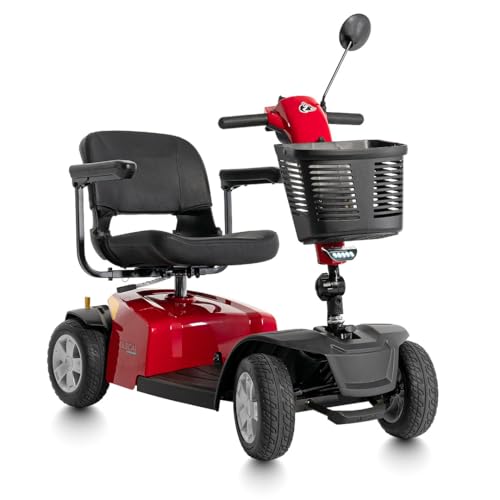
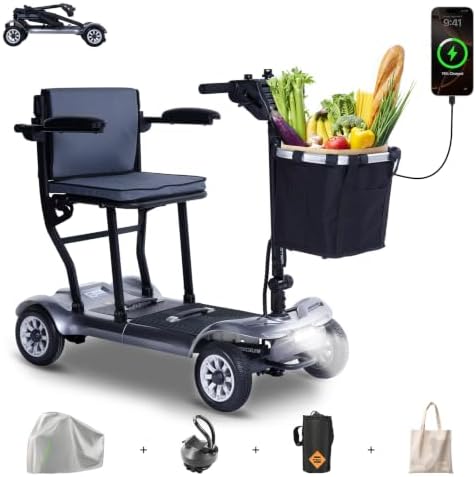
Here are the picks together, with live prices pulled from Amazon. The reasoning behind each one is in the write-ups above, and none of these positions were paid for.


Please read this
A mobility scooter is a medical mobility device, not a gadget, and the wrong one creates a genuine fall risk. Before buying, we strongly recommend an assessment by a doctor, physical therapist, or occupational therapist. They can confirm whether a scooter is the right device at all, and what size and configuration suits the person using it.
A mobility scooter assumes the rider can: sit upright without support, transfer on and off safely, steer with both hands, and see well enough to judge kerbs and traffic. If any of those is uncertain, a power wheelchair is usually the more appropriate device, and that decision should be made with a professional rather than from a product page.
Nothing on this page is medical advice.
How we picked. These recommendations come from research, not from us testing every scooter. We compared published specifications, weight capacities, and the weight of expert and long-term owner reviews. We have not personally used every model here, and we say so plainly rather than imply otherwise.
Sources
- US Food and Drug Administration — 21 CFR 890.3910, motorized three-wheeled vehicle, the regulation that classifies mobility scooters as medical devices.
- US Food and Drug Administration — Product classification: powered wheelchair, for how powered wheelchairs are regulated as Class II devices.
Checked September 2026. Regulations and published figures change; verify the current source before acting on anything here.
Keep reading
- All mobility scooter guides
- Best airline-approved mobility scooters
- How to transport a mobility scooter or wheelchair in a car
- Mobility scooter vs power wheelchair: how to choose
- Best heavy-duty and all-terrain mobility scooters
- Does Medicare cover a mobility scooter?
- Getting around without driving
- Electric scooters for adults, a different category entirely
- E-bikes and assisted cycling
- Three wheels or four? Choosing a mobility scooter
- Best travel and portable mobility scooters, if it has to fold and be lifted