Heavy-duty scooters solve two different problems, and it is worth knowing which one you have.
One is weight: standard scooters are typically rated around 250 to 300 lb, which rules them out for a lot of riders. The other is ground: grass, gravel, kerbs, slopes and unpaved paths, where a small-wheeled indoor scooter is simply the wrong machine.
Most of the models here address both. They are large, heavy, outdoor machines. None of them is a travel scooter, none folds into a car boot, and none is what Medicare buys.
Disclosure: Sustainable Transportation is reader-supported. When you buy through links on this page, we may earn an affiliate commission at no extra cost to you. A commission never buys a better ranking. See our affiliate disclosure.
Who this guide is for
- Riders above roughly 300 lb, where standard scooters are not rated to carry you safely.
- Anyone whose daily route includes grass, gravel, kerbs or slopes rather than smooth pavement.
- People who want genuine outdoor range instead of a short hop to the shop.
- People who have somewhere to store and charge a large machine, and a way to move it that does not involve lifting it.
If you need something that folds into a car, read travel and portable scooters instead. If you mainly need help indoors and around the neighbourhood, start with mobility scooters for seniors.
Weight capacity: read the number properly
The rated capacity is a maximum under good conditions: level ground, smooth surface, nothing loaded. It is not a target to sit close to.
Everything real-world eats into that margin. A slope shifts load onto the rear axle. A kerb delivers a shock load several times the static weight. Shopping in the basket counts. Riding a scooter continuously near its rated limit is how motors overheat on hills, how batteries age early, and how frames and castors fail sooner than they should.
Practical rule: leave meaningful headroom above the rider weight. If you are near 300 lb, a 500 lb machine is a far better long-term buy than a 350 lb one, and the price gap is usually smaller than the repair bill.
What all-terrain actually requires
- Pneumatic tyres. Air does the shock absorption and gives grip on loose ground. Solid tyres on a heavy scooter transmit every bump straight to the rider.
- Real suspension, front and rear. On rough ground this is a comfort feature and a safety feature, because it keeps the wheels in contact with the surface.
- Ground clearance and wheel size. Larger wheels roll over obstacles that stop small ones. This matters more than motor wattage.
- A four-wheel frame. Three wheels turn tighter but are easier to tip on a camber or slope, which is exactly where these machines are used.
- Motor power, last. Wattage sells scooters, but tyres, suspension and wheel size decide whether the thing is usable off pavement.
A warning about very new listings
Several heavy-duty scooters, including two on this page, are recent listings with only a handful of owner reviews. A five-star average drawn from one or two reviews tells you essentially nothing.
This matters more here than in most categories. These are machines costing well over a thousand dollars, carrying a person who may not be able to recover easily from a fall, often with no local dealer and no established service history. Warranty support from a young brand is an unknown.
We publish the real counts throughout so you can weigh that yourself. Where a product is new, we say so, and we do not let a thin five-star average outrank a well-evidenced four-star one.
Our picks
1. Best Overall: Ecomobi MS02 MAX 1000W

Who it is for: the default recommendation for most people needing a heavy-duty outdoor scooter.
- Capacity: 500 lb
- Motor: 1000W
- Range: up to 32 miles claimed
- Owner rating: 4.3 stars from 65 ratings, checked August 2026
Why it wins: evidence. Sixty-five ratings is far more owner data than anything else in this class carries, and at the time of checking it was also cheaper than the newer alternatives below. A 4.3 average across 65 buyers is a more useful signal than a 5.0 across one, and it is the combination of capability, price and track record that puts it first.
It ranks first on evidence and price, which is the only basis we rank on.
The honest con: 4.3 is good, not flawless, and at 65 reviews you can read the critical ones. Do that before buying. We cover an important caveat on this model in our seniors guide.
2. Highest Capacity: ATmobi 550 lb Extra-Wide
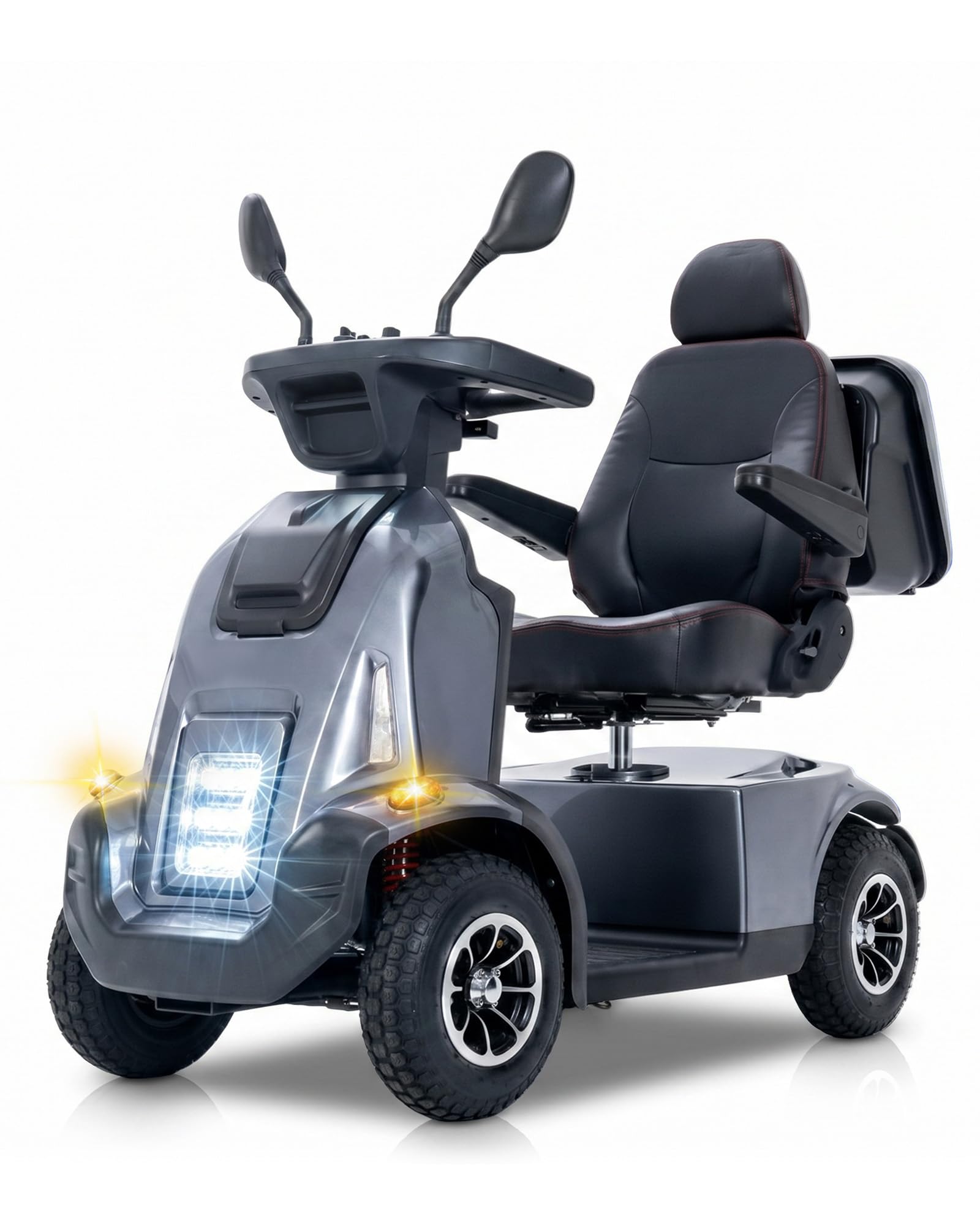
Who it is for: riders who need more than 500 lb of capacity, or who want a wider seat. This is the only genuinely bariatric option here, and it is a badly served group.
- Capacity: 550 lb, the highest on this page
- Motor: 1000W
- Tyres: 13-inch off-road
- Range: up to 32 miles claimed
- Slope rating: 15 degrees
- Suspension: full
- Owner rating: 5.0 stars from just 2 ratings, checked August 2026
Why it earns a place: the capacity is real and rare. If you are above 500 lb, most of this market simply does not serve you, and an extra-wide seat is a comfort difference rather than a specification line. It wins its category on a measurable spec, not on our commission.
The honest con, and it is a big one: two reviews. We cannot tell you how this holds up over a year, because nobody can yet. Buy it because the capacity solves a problem nothing else here solves, not because of the star rating.
3. Most Equipped All-Terrain: ATmobi 500 lb
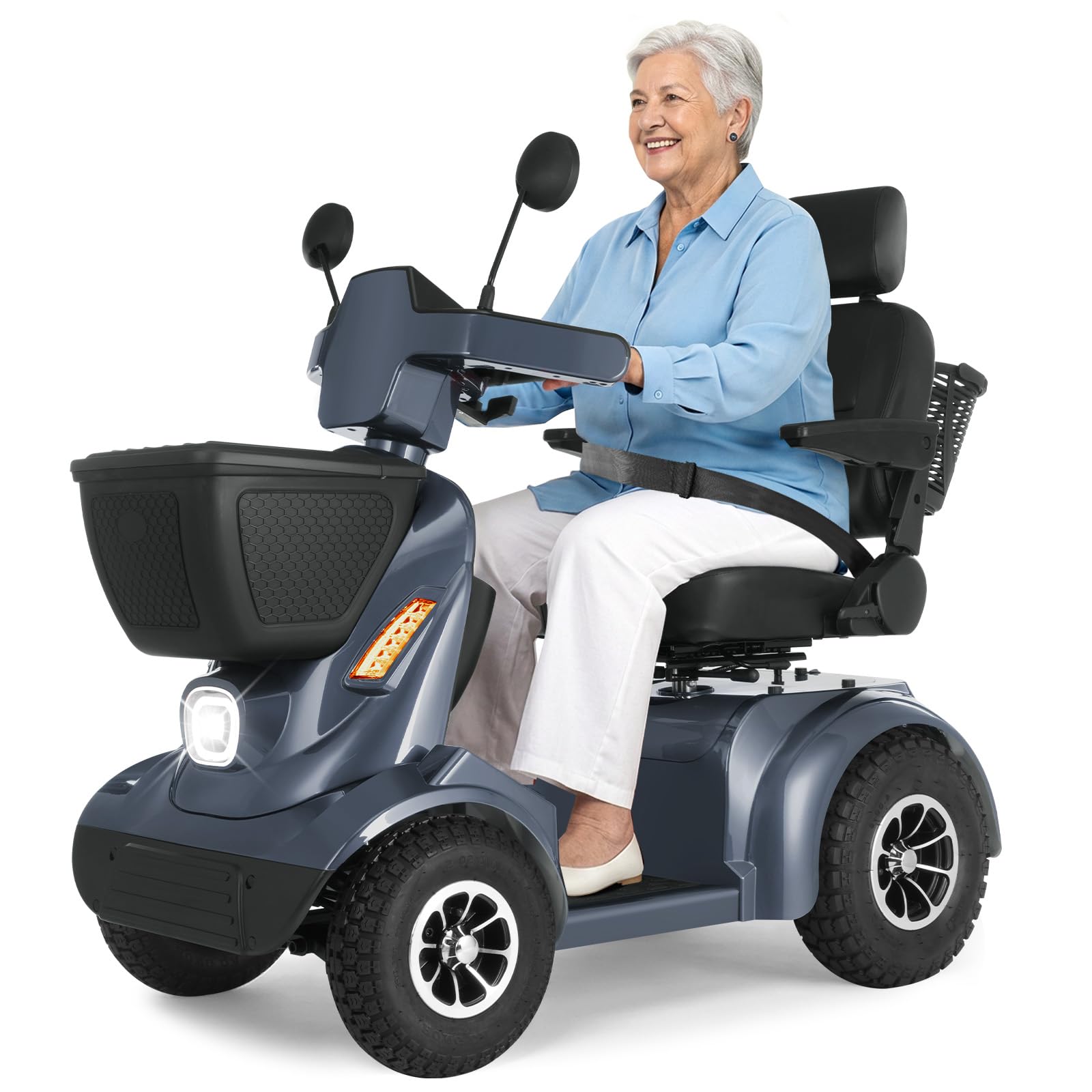
Who it is for: riders under 500 lb whose priority is rough ground rather than maximum capacity.
- Capacity: 500 lb
- Motor: 1000W peak
- Tyres: 14-inch off-road, the largest here
- Suspension: full
- Top speed: 15 mph
- Range: up to 32 miles claimed
- Owner rating: 5.0 stars from a single rating, checked August 2026
Why it earns a place: the 14-inch tyres are the largest on this page, and wheel size is the specification that most determines whether a scooter copes with kerbs, ruts and loose gravel. Combined with full suspension, this is the most genuinely off-road machine of the three.
The honest cons. First, one review. Second, 15 mph is fast for a mobility scooter, where 4 to 8 mph is typical. That speed is useful on open ground and unforgiving elsewhere; use the lower speed setting around people. Third, we found a discrepancy between the battery capacity in the brand’s promotional material and the figure on the product listing, so we have not printed a watt-hour number here. We have asked the brand and will publish it when confirmed.
Who a heavy-duty scooter is NOT for
- Anyone who needs to transport it by car. These do not fold and cannot be lifted. Buy a portable scooter.
- Anyone whose main need is indoors. They are too large and turn too wide for hallways and shop aisles.
- Anyone hoping Medicare will pay. See what Medicare actually covers before you spend anything.
- Anyone who cannot transfer on and off unaided, sit upright without support, or operate a tiller safely. That is a power wheelchair assessment, not a scooter purchase.
- Anyone without secure, weatherproof storage and a nearby socket. These live outdoors or in a garage and need charging where they stand.
Frequently asked questions
What counts as a heavy-duty mobility scooter?
In practice, a rated weight capacity of roughly 350 lb or more, a larger motor, and a frame and suspension built for outdoor use. Standard scooters are usually rated around 250 to 300 lb and are designed for flat, even surfaces.
How much weight capacity do I actually need?
Choose a rating comfortably above the rider weight, not equal to it. The rated figure is a maximum on level ground. Slopes, kerbs, rough surfaces and anything carried in a basket all eat into that margin, and running a scooter at its limit shortens the life of the motor, the battery and the frame.
Will Medicare pay for a heavy-duty all-terrain scooter?
Almost certainly not. Medicare assesses whether you need a device to move around inside your home. These machines are built for outdoor use, which is the use Medicare does not base coverage on. Treat them as a retail purchase.
Is 15 mph safe on a mobility scooter?
It is considerably faster than a typical mobility scooter, which is often limited to 4 to 8 mph. Speed is useful on open ground, but it also shortens reaction time and increases the consequences of a mistake. Any scooter with that top speed should have a lower speed setting, and it should be used.
Do all-terrain scooters work on grass and gravel?
Pneumatic tyres, real suspension and adequate ground clearance are what make the difference, far more than motor power. Solid tyres on a heavy machine transmit every bump to the rider and struggle for grip on loose surfaces.
Can a heavy-duty scooter be transported in a car?
Generally not without a hoist or a vehicle ramp. These weigh a great deal more than a folding travel scooter and do not disassemble into liftable pieces. If the scooter has to go in a car boot, you want a portable model instead.
Why do some of these have very few reviews?
Several heavy-duty scooters are recent listings from newer brands. A high star rating drawn from one or two reviews carries almost no information. We publish the actual counts so you can judge for yourself rather than reading a five-star average as proof.
Please read this
A mobility scooter is a medical mobility device, and the wrong one is a genuine fall risk. We strongly recommend an assessment by a doctor, physical therapist or occupational therapist before buying, particularly for a machine this size and this fast.
We do not test these products. Our recommendations are based on published specifications, stated capacities, owner feedback and price. We have not ridden any scooter on this page, and we say so rather than implying experience we do not have.
Specifications and prices change. Everything here was checked in August 2026. Verify the current listing before you buy.
The picks side by side
Prices on these move constantly, so the table pulls live figures rather than numbers we typed in once.


Sources
- US Food and Drug Administration — 21 CFR 890.3910, motorized three-wheeled vehicle, the regulation that classifies mobility scooters as medical devices.
- US Food and Drug Administration — Product classification: powered wheelchair, for how powered wheelchairs are regulated as Class II devices.
Checked September 2026. Regulations and published figures change; verify the current source before acting on anything here.
Keep reading
- All mobility scooter guides
- Best airline-approved mobility scooters
- How to transport a mobility scooter or wheelchair in a car
- Mobility scooter vs power wheelchair: how to choose
- Best mobility scooters for seniors
- Best travel and portable mobility scooters
- Does Medicare cover a mobility scooter?
- Three wheels or four?