MOBILITY · BUYING GUIDE · RESEARCH-BASED
The short answer
A travel scooter is bought for one reason: somebody has to lift it. Everything else, range, comfort, top speed, is secondary to whether the heaviest single piece can be picked up and put in a car boot without hurting anyone.
Our pick is the Pride Mobility Go-Go Super Portable. It is the only one here that is an FDA Class II medical device with an airline-approved battery, and it folds without removing the seat.
Before you buy: a mobility scooter is a medical mobility device, and the wrong one is a genuine fall risk. We strongly recommend an assessment by a doctor, physical therapist or occupational therapist first. They can confirm whether a scooter is the right device at all. Our full guidance is in the main mobility scooter guide.
Disclosure: Sustainable Transportation is reader-supported. When you buy through links on this page, we may earn an affiliate commission at no extra cost to you. A commission never buys a better ranking. See our affiliate disclosure.
The number that actually matters
Manufacturers advertise total weight. That figure is close to useless, because nobody lifts the whole scooter assembled.
What matters is the heaviest single piece once the battery and seat come off. On most travel scooters that is the frame, between roughly 30 and 45 lb. Ask who will be lifting it, and whether they can manage that weight repeatedly, into a boot, at hip height, possibly in the rain.
The second number is folded dimensions. Measure your boot before you shop, not after.
Our picks
1. Best Overall: Pride Mobility Go-Go Super Portable

Who it is for: anyone who flies, or who wants the reassurance of an established medical-device manufacturer rather than an unbranded import.
- Certification: stated as an FDA Class II medical device
- Battery: 11.7Ah lithium-ion, described as airline-approved
- Range: up to 10 miles per charge
- Weight: 41 lb without the battery
- Folding: folds to 12 inch depth without removing the seat
- Capacity: up to 300 lb
- Top speed: up to 4.5 mph
- Extras: front and rear LED lights, USB port, under-seat storage, magnetic Charge 360 connector
- Owner rating: 4.9 stars from 7 ratings, checked August 2026
Why it earned this spot: two things nothing else here matches. It is an FDA Class II medical device, which means it is regulated as a mobility aid rather than sold as a consumer gadget, and Pride is one of the established names in the category with a dealer and service network behind it. The airline-approved battery is the other: if you fly, that single specification decides whether the scooter travels with you at all. Folding without removing the seat sounds minor until you are doing it in a car park.
The honest con: 10 miles is the shortest claimed range here, and 41 lb without the battery is heavier than the two below. Seven owner ratings is also a thin evidence base, though Pride as a manufacturer has a far longer track record than the newer brands.
Skip it if: lifting 41 lb is the binding constraint. Look at the ATmobi below.
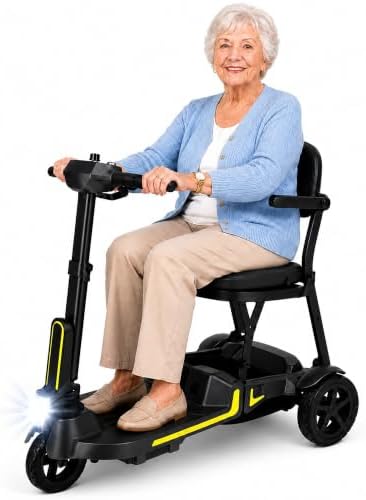
2. Lightest Frame: ATmobi X3

Who it is for: the household where lifting weight is the deciding factor, and the person loading the car is not strong.
- Certification: the listing does not state FDA Class II status
- Weight: 31.7 lb frame without seat and batteries, the lightest here
- Folding: one piece, no disassembly, folds to 11.8 x 19.7 x 33.8 inches
- Battery: dual 8Ah for up to 20 miles, or dual 12Ah for up to 32 miles
- Wheels: 3 wheels, 8 inch
- Safety: rear anti-tip wheels, electromagnetic braking, rear tail light
- Comfort: 2 inch padded seat, under-seat basket
- Owner rating: 5.0 stars from 3 ratings, checked August 2026
Why it earned this spot: 31.7 lb is genuinely light for a scooter that still carries an adult, and the one-piece fold matters more than the number suggests. Scooters that disassemble into three or four pieces sound portable until you are doing it twice a day. The dual-battery option is also unusual at this weight: 32 miles from a folding scooter is more than most full-size models.
The honest con: three owner ratings, no stated FDA Class II status, and it is a three-wheeler, which turns tighter but is less stable laterally, exactly the trade-off we cover in three wheels or four. On cambered pavements that matters.
Skip it if: the user is unsteady or the ground is uneven. Stability should beat portability in that case.
3. Best Four-Wheel Portable: SCOOTNGO Voyager

Who it is for: someone who wants four-wheel stability without giving up the ability to fold and lift it.
- Certification: the listing does not state FDA Class II status
- Weight: 33 lb frame, battery removable separately
- Wheels: four, carbon fibre with solid silent tyres
- Battery: 24V 11.6Ah, up to 13 miles
- Capacity: 275 lb
- Safety: automatically slows when turning to reduce roll risk
- Controls: panel with voice prompts and adjustable speed
- Owner rating: 5.0 stars from 7 ratings, checked August 2026
Why it earned this spot: four wheels at 33 lb is a genuinely difficult combination, and most portable scooters solve it by dropping to three. The automatic slowdown on turns is the detail worth noting: turning too fast is one of the most common ways these tip, and designing that out is more useful than any comfort feature. Solid tyres also mean no punctures.
The honest con: 275 lb is the lowest capacity here, no stated FDA Class II status, and solid tyres transmit more road buzz than pneumatic ones. 13 miles is modest, though realistic for daily errands.
Skip it if: the rider is near the 275 lb limit, or most use is on rough ground where a full-size scooter suits better.
What portability costs you
Every travel scooter is a set of compromises, and it is worth being clear about them before buying:
- Smaller wheels mean less comfort and worse behaviour on kerbs, grass and gravel.
- Lower ground clearance turns ordinary thresholds into obstacles.
- Smaller batteries mean shorter range, usually 10 to 20 miles rather than 30 plus.
- Lighter frames generally mean lower weight capacity.
- Less padding, because seats are made lighter and thinner.
If the scooter will mostly stay at home and rarely go in a car, a full-size model is more comfortable and more capable. Our main guide covers those.
Flying with a mobility scooter
The battery decides everything. Airlines regulate lithium batteries by watt-hour rating, and many require the battery to be removed and carried in the cabin rather than in the hold.
- Confirm the watt-hour rating of the battery and check it against your airline’s published limit.
- Tell the airline in advance. Most require notice for mobility equipment.
- Keep the manufacturer documentation with you, since it states the battery type and rating.
- Expect to remove the battery at the gate and carry it on board.
A scooter advertised as having an airline-approved battery has usually been designed around these rules, which is why it is the specification we weight most heavily for travel use.
Frequently asked questions
What is the best travel mobility scooter for seniors?
For most people the Pride Mobility Go-Go Super Portable, because it is an FDA Class II medical device with an airline-approved lithium battery and folds without removing the seat. If outright lightness matters more, the ATmobi X3 frame is 31.7 lb.
Can you take a mobility scooter on a plane?
Usually yes, but the battery decides it. Airlines require lithium batteries within specific watt-hour limits, and many require the battery to be removed and carried in the cabin. Look for a scooter described as having an airline-approved battery, and always confirm with your airline in advance.
How much do portable mobility scooters weigh?
Travel models typically range from about 30 to 45 lb for the heaviest single piece once the battery and seat are removed. That heaviest piece is the number that matters, because it is what someone has to lift into a car boot.
What is the difference between a travel scooter and a regular mobility scooter?
Travel scooters are built to fold or disassemble and to be lifted, so they use smaller batteries, smaller wheels and lighter frames. They trade range, ground clearance and outdoor stability for portability. A full-size scooter is more comfortable and capable but is not designed to be lifted regularly.
Are folding mobility scooters good for outdoor use?
For pavements and flat ground, yes. For grass, gravel or rough terrain they are less suitable, because small wheels and low ground clearance are the price of portability. If most of your use is outdoors on uneven ground, a full-size four-wheel model is the better choice.
How far can a portable mobility scooter go on one charge?
Commonly 10 to 20 miles, with some dual-battery models claiming more. Treat manufacturer figures as a ceiling measured with a light rider on flat ground. Plan around roughly half the headline number if you use hills or carry shopping.
The picks side by side
Prices move constantly on these, so the table pulls live figures rather than numbers we typed in and forgot about.


Sources
- US Food and Drug Administration — 21 CFR 890.3910, motorized three-wheeled vehicle, the regulation that classifies mobility scooters as medical devices.
- US Food and Drug Administration — Product classification: powered wheelchair, for how powered wheelchairs are regulated as Class II devices.
Checked September 2026. Regulations and published figures change; verify the current source before acting on anything here.
Keep reading
- All mobility scooter guides
- Best airline-approved mobility scooters
- How to transport a mobility scooter or wheelchair in a car
- Mobility scooter vs power wheelchair: how to choose
- Best heavy-duty and all-terrain mobility scooters
- Does Medicare cover a mobility scooter?
- Best mobility scooters for seniors, the full-size guide
- Three wheels or four? Choosing a mobility scooter
- What is sustainable transportation?