HUB · E-BIKES
An e-bike is the highest-leverage transportation swap most people can make. Roughly half of all car trips in the US are under three miles, and those are exactly the trips an e-bike replaces best: too far to walk comfortably, short enough that a bike is often faster door-to-door once you count parking. This hub covers how to choose one, what the specs actually mean, and what it really costs to own.
Start here
 Buying guide
Best Commuter E-Bikes
Five bikes ranked on UL 2849 certification and how much real owner feedback exists, with the honest cons.
Read the guide → Buying guide
Best Folding E-Bikes
For small flats and transit. Only one of these is genuinely light enough to carry, and we say which.
Read the guide → Buying guide
Best Cargo E-Bikes
The bikes that can actually replace a second car for the school run and the weekly shop.
Read the guide →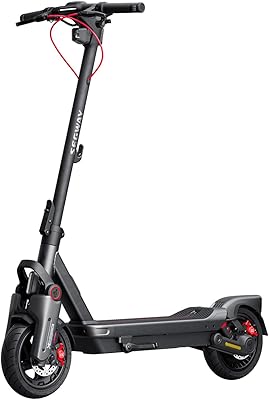 Buying guide
Best Electric Scooters for Adults
Five scooters ranked, and which ones actually state UL 2272 certification rather than implying it.
Read the guide → Buying guide
Electric Dirt Bikes for Adults
Serious machines, plus the legal categories that catch buyers out after the money has gone.
Read the guide → Buying guide
Essential E-Bike Commuter Gear
Locks, lights, panniers and pumps. What to buy first, and what you can safely skip.
Read the guide →ExplainerE-Bike Classes 1, 2 and 3
What each class means, where you are allowed to ride it, and which one you probably want.
Read the explainer →CalculatorE-Bike vs Car: 5-Year Cost
Put in your own mileage and running costs and see what swapping some car trips really saves.
Open the calculator →The five specs that actually decide whether you like the bike
1. Brakes: hydraulic disc, no exceptions
An e-bike weighs 50 to 70 pounds and travels at 20 to 28 mph. That is far more energy to stop than a regular bike, and mechanical (cable) disc brakes fade badly in the wet and need constant adjustment. Hydraulic disc brakes self-adjust as the pads wear and give you real stopping power with one finger. If a bike has mechanical brakes, that is the manufacturer telling you where they saved money, and it is the worst possible place to save it.
2. Torque sensor vs cadence sensor
This single component decides how the bike feels. A cadence sensor detects only that the pedals are turning and delivers a fixed amount of power, so it feels like an on/off switch: you pedal, a motor shoves you forward, you stop pedalling, it cuts out. A torque sensor measures how hard you are actually pushing and multiplies it, so the bike feels like a stronger version of you rather than a scooter that requires pedalling.
Torque sensors also stretch range, because the motor works proportionally instead of dumping full power at every pedal stroke. Cadence-sensor bikes are cheaper and perfectly usable, especially on flat routes, but if you can afford the step up, this is where the money is best spent after brakes.
3. Hub motor vs mid-drive
A hub motor sits in the wheel and pushes it directly. It is cheaper, simpler, nearly silent, and needs no maintenance. Its weakness is hills: it cannot use the bike’s gears, so on a steep climb it strains at low speed.
A mid-drive sits at the pedals and drives the chain, so it uses your gears exactly like your legs do. It climbs far better, balances the bike’s weight centrally, and feels the most natural. The trade-offs: it costs more and it wears out chains and cassettes faster because all that torque runs through them.
The simple rule: flat commute, buy a hub motor and save the money. Genuinely hilly commute, a mid-drive is worth every dollar.
4. Range: treat the headline number as fiction
Manufacturers quote range under laboratory-perfect conditions: lowest assist level, flat ground, no wind, a light rider, mild temperature. Real riding conditions all reduce it. Hills, higher assist, cold weather, a heavier rider, cargo, headwind, and stop-and-go traffic each take a bite.
The practical approach: work out your actual daily round trip, then buy a bike whose claimed range is comfortably more than double it. That way you are never range-anxious and you are not deep-cycling the battery every day, which shortens its life.
5. What is included, and what the battery will cost later
On a commuter bike, integrated lights, fenders, and a rack should be standard. Buying them separately typically adds $150 to $300, plus the fitting hassle, so a slightly pricier bike that includes them is often the cheaper bike.
The cost people forget is the battery. E-bike batteries typically hold up for several hundred full charge cycles before capacity noticeably drops, and a proprietary replacement often runs $400 to $700. That is not a reason to avoid e-bikes, it is a reason to include it in your cost comparison from the start, which is what our cost calculator does.
Which type of e-bike fits your life
- Commuting 3 to 12 miles: a standard commuter with a torque sensor, hydraulic brakes, lights, and fenders. This suits the largest number of people.
- Hauling kids or groceries: a cargo bike (longtail or front-loader). These are the bikes that genuinely replace a second car, and they are heavy and long, so measure your storage first.
- Apartments, offices, or bike-plus-train: a folding e-bike. Smaller wheels ride firmer, but a folder solves the storage problem that stops most would-be riders.
- Short, flat trips only: consider whether you need a motor at all. A good regular bike is lighter, cheaper, and simpler.
Understanding e-bike classes
The US uses a three-class system. Class 1 is pedal-assist only, with the motor cutting out at 20 mph. Class 2 adds a throttle, still capped at 20 mph. Class 3 is pedal-assist up to 28 mph, which makes it the fastest option for covering distance but the most restricted on shared paths.
Why it matters: many bike paths and trails allow Class 1 and 2 while restricting Class 3, and rules vary by state and even by city. If your route uses a multi-use path, check its rules before choosing a class. For pure road commuting, Class 3 gets you there faster.
When an e-bike is NOT the answer
We are not going to pretend this works for everyone. An e-bike is a poor fit if you have nowhere secure to store or charge it, if your route has no safe road or bike infrastructure, if you regularly carry passengers or heavy loads a cargo bike cannot handle, or if a health condition makes cycling unsafe. Long rural distances in bad weather are also a genuinely hard case. If that is you, the honest advice is to look at an efficient EV instead.