SCOOTERS · BUYING GUIDE · RESEARCH-BASED
The short answer
For most adults commuting under 10 miles each way, the Segway Ninebot MAX G3 is the safest all-round buy: long real-world range, suspension, and the best reliability record in the category. If you want to spend far less, the Gotrax GXL V2 covers short flat trips at a fraction of the price. Buy for brakes, tires, and weight before you buy for top speed, because those are what you actually feel every single ride.
Disclosure: Sustainable Transportation is reader-supported. When you buy through links on this page, we may earn an affiliate commission at no extra cost to you. A commission never buys a better ranking. See our affiliate disclosure.
What actually matters when buying
Brakes come first
Look for a mechanical brake, disc or drum, on at least one wheel, and ideally both. Some cheap scooters rely mainly on regenerative (electronic) braking, which fades as the battery fills and is not something to trust in an emergency stop. Small wheels and a standing posture already make scooters less stable than bikes under hard braking, so this is not the place to economise.
Tires change the ride more than the motor
Pneumatic (air-filled) tires absorb bumps, grip better in the wet, and make a scooter tolerable on real pavement. Solid tires never puncture, which is genuinely convenient, but they transmit every crack in the road and offer less grip.
For most riders on ordinary city streets, pneumatic tires are worth the occasional flat. Choose solid only if your route is smooth and you cannot tolerate any downtime.
Treat range claims as a ceiling
Advertised range assumes a light rider, flat ground, mild weather, and modest speed. Real riding uses more, and rider weight, hills, cold, and higher speed each take a bite. A useful rule: plan for meaningfully less than the claim, and buy a scooter rated for roughly double your daily round trip. That way you are not deep-discharging the battery daily, which shortens its life.
Weight is the spec people regret ignoring
Scooters are marketed as portable, and lighter models genuinely are. But performance scooters can weigh 50 to 80 pounds. If your plan involves carrying it onto a train, up stairs, or into an office daily, weigh that honestly, because it is the single most common reason a scooter ends up unused in a hallway.
Water resistance and safety
Look for a stated IP rating (IPX4 handles splashes, IPX6 handles heavier rain) if you ride year-round. And wear a helmet. Scooter injury data consistently shows head injuries are the most serious risk and that most injured riders were not wearing one. Small wheels are unforgiving of potholes in a way bicycle wheels are not.
Scooter or e-bike?
They solve overlapping problems, and the honest answer depends on distance and storage.
- A scooter wins for trips under about 5 miles, tight storage, pairing with transit, and the lowest possible entry price. There is no chain, no gears, and nothing to maintain but tires and brakes.
- An e-bike wins for longer distances, rough pavement, hills, comfort, and carrying anything. Bigger wheels are safer over potholes, and you can add a rack or panniers.
If your trips are mostly 5 to 12 miles, read our commuter e-bike guide instead. If they are 1 to 4 miles and storage is tight, a scooter is probably the better tool.
Our picks
Five scooters, ranked. For scooters the safety standard to look for is UL 2272, which covers the electrical drive system, usually alongside UL 2271 for the battery. Only two of these five state it, and we say which in every entry.
One more thing worth knowing before you read on: most scooter listings on Amazon cover several models at once, which is why you see ranges like “25 to 43.5 mph”. The headline figures usually describe the most expensive variant. Always check which model you are actually buying.
1. Best Overall: Segway Ninebot MAX G3

Who it is for: the commuter who wants the safest, least dramatic option and is happy to pay for it. If you buy one scooter and never think about it again, this is that scooter.
- Certification: ANSI/CAN/UL-2272 certified by TUV Rheinland, and UL 2271 for the battery
- Battery: 597Wh
- Claimed range: up to 50 miles
- Top speed: 22 to 28 mph depending on model
- Tires: 11 inch self-sealing tubeless, seal punctures up to 4mm automatically
- Suspension and brakes: dual suspension, dual braking
- Charging: 3.5 hours built in, 2.5 hours with the optional DC charger
- Durability testing: 12,427 miles of simulated vibration, 500,000 suspension cycles
- Owner rating: 4.3 stars from 14 ratings, checked August 2026
Why it earned this spot: it is the only scooter here whose certification names the testing body. “UL 2272 certified by TUV Rheinland” is a checkable claim; “UL certified” on its own is not. The self-sealing tubeless tires are the other reason. Punctures are the single most common thing that takes a scooter off the road, and these seal themselves without you knowing.
The honest con: Segway publishes durability numbers and third-party certification, and you pay for both. It is not the cheapest way to travel three miles. Note: this is a multi-model listing, so the headline range and speed figures cover several variants. Confirm which model is in your cart before ordering.
Skip it if: your trip is under about 3 miles on smooth pavement. The Gotrax does that for much less money.
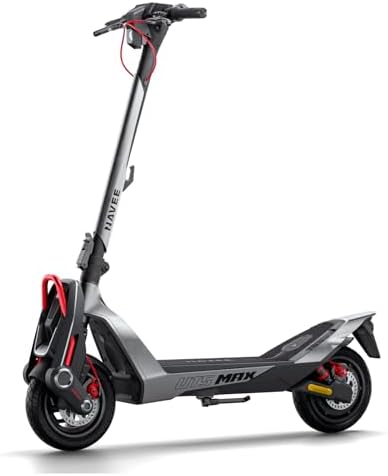
2. Longest Range and Most Owner Feedback: NAVEE UT5 Series

Who it is for: a long commute, a hilly one, or a heavier rider. This is the scooter for people whose route defeats normal scooters.
- Certification: the listing does not state UL 2272
- Battery: 716Wh, with a 2-hour Flash Charge
- Claimed range: up to 62.1 miles on the UT5 Max
- Top speed: 25 to 43.5 mph across the model range
- Motor: 1638W to 2400W peak depending on model
- Tires: 12 inch self-healing tubeless
- Braking: front disc, rear disc, and regenerative EABS
- Lighting: 6W auto-sensing front, 2W stop light, handlebar turn signals
- Extras: traction control, Bluetooth lock, Apple Find My, IPX6
- Capacity and weight: 330 lb rider limit, 75 lb scooter, folds to 25.4 inches
- Owner rating: 4.2 stars from 113 ratings, checked August 2026
Why it earned this spot: 113 owner ratings is roughly eight times what any other scooter in this guide has, and it still holds 4.2 stars. That is the most meaningful reliability signal available here. The hardware backs it up: a 716Wh battery, traction control, three-stage braking, turn signals, and a 330 lb rider limit that most scooters cannot touch.
The honest con: it weighs 75 lb. That is not a scooter you carry up stairs or lift into a car boot without help, and it changes what “portable” means entirely. The listing also does not state UL 2272 certification, which is a real gap next to the Segway. Note: this is a multi-model listing, so the headline range and speed figures cover several variants. Confirm which model is in your cart before ordering.
Skip it if: you need to carry it, or certification is non-negotiable. Both point to the Segway.
3. Best Value and Lightest: Gotrax GXL V2

Who it is for: short trips, tight budgets, and anyone who has to carry the scooter at either end of the ride.
- Certification: UL 2272, stated in the listing
- Motor: 250W
- Battery: 36V 5.2Ah, roughly 187Wh
- Claimed range: 12 miles
- Top speed: 15.5 mph
- Tires: 8.5 inch solid honeycomb, puncture-proof and maintenance-free
- Weight: 27 lb, by far the lightest here
- Folded size: 43.7 x 17.3 x 16.1 inches
- Rider limit: 220 lb
- Owner rating: 3.9 stars from 14 ratings, checked August 2026
Why it earned this spot: 27 lb and UL 2272 certification at this price is a genuinely good combination. Solid honeycomb tires mean you will never fix a puncture, which for a short-trip scooter removes the main maintenance headache. Gotrax has also been selling this model long enough that it is a known quantity rather than a new listing.
The honest con: a 250W motor and a 187Wh battery are modest. On any real hill you will slow noticeably, and the 12 mile range is a best case on flat ground with a light rider. Solid tires also transmit far more road buzz than pneumatic ones, which is tiring over distance. It carries the lowest owner rating in this guide at 3.9 stars.
Skip it if: your route has hills, rough pavement, or is over about 5 miles. The motor and the tires both become the limitation.
4. Best App and Braking Package: NIU 300P and 300X

Who it is for: a mid-range commuter who wants app control, theft locking, and better brakes than the budget tier without going to 75 lb.
- Certification: the listing does not state UL 2272
- Motor: 600W to 1000W peak depending on model, 900W on the 300P
- Claimed range: 18 to 37.3 miles across the range, about 30 miles on the 300P
- Top speed: 17.4 to 23.6 mph depending on model
- Hill grade: 20 percent on the 300P
- Tires: XL tubeless with all-terrain suspension
- Braking: front disc, rear disc, and rear electric brake
- App: lock, speed customisation, cruise control, charge limiting to extend battery life
- Owner rating: 4.0 stars from 5 ratings, checked August 2026
Why it earned this spot: the triple braking system and tubeless all-terrain tires are a real step up from the budget tier, and the app charge limit is a feature we wish more scooters had, because keeping a lithium pack off 100 percent meaningfully extends its life. Wider bars and a wider deck also make a longer ride less tiring.
The honest con: the listing does not state UL 2272 certification, and it had only 5 owner ratings when we checked. Note: this is a multi-model listing, so the headline range and speed figures cover several variants. Confirm which model is in your cart before ordering. The 300P and 300X are quite different machines.
Skip it if: certification is a hard requirement, or you want a proven track record. The Segway covers both.
5. Best Off-Road Comfort: Apollo Go and Explore

Who it is for: someone whose route includes broken pavement, gravel, or park paths, and who rides at night.
- Certification: the listing does not state UL 2272
- Motors: dual 350W, 1500W combined peak
- Battery: 21700 cells
- Claimed range: 30 miles in eco, 20 in standard, 15 in sport
- Top speed: 28 mph
- Suspension: Airflow, front spring damping with rear polyurethane
- Tires: self-healing PunctureGuard
- Lighting: 360 degree system with 5 separate light sources
- Owner rating: 4.2 stars from 3 ratings, checked August 2026
Why it earned this spot: Apollo is unusually honest about range, quoting three figures for three modes rather than one optimistic number. That alone tells you something. Dual motors and real suspension make rough ground genuinely comfortable, and the five-point lighting system is the best visibility package in this guide, which matters more than most people admit for evening riding.
The honest con: the listing does not state UL 2272, and with 3 owner ratings there is no reliability history to lean on. Note also what the honest range figures actually mean: ride it in sport mode, which is why you bought a 28 mph scooter, and you get about 15 miles.
Skip it if: you want certification or long range in the fast modes. In sport mode this is a short-range scooter.
Who this is NOT for
- Anyone whose route has rough roads, potholes, or no bike infrastructure. Small wheels are far less forgiving than bicycle wheels, and this is a genuine safety issue rather than a comfort one.
- Riders who need to carry cargo or passengers. A scooter carries you and a backpack. That is the limit.
- Long commutes, where standing for 40 minutes stops being pleasant and an e-bike is simply the better vehicle.
- Anywhere scooters are restricted. Rules vary widely by city and state, including where you may ride and how fast. Check before buying.
- Riders with balance or joint concerns, since standing on a small platform over rough ground is demanding in a way sitting on a bike is not.
Frequently asked questions
Are electric scooters street legal?
It depends entirely on where you live. Many US states and cities permit them in bike lanes with speed caps, while others restrict them on sidewalks or certain roads, and some require a helmet or set a minimum age. Rules have changed quickly in recent years. Check your state’s transportation department and your city’s specific ordinance before buying, particularly if you are considering a high-speed model.
How long does an electric scooter last?
The battery is usually the limiting part, typically holding up for several hundred charge cycles before capacity noticeably drops. Habits that extend it: avoid storing at 0 or 100 percent for long periods, charge indoors at moderate temperatures, and avoid running it flat regularly. A quality scooter that is maintained can last years; a very cheap one often fails at the stem, folding mechanism, or battery well before that.
Can I ride in the rain?
Light rain is generally fine if the scooter has a stated IP rating such as IPX4 or higher. Standing water and heavy downpours are a different matter, since water ingress can damage electronics and is often excluded from warranty. Braking distance also increases meaningfully on wet ground, so slow down.
Do I need insurance?
In most US jurisdictions a personal electric scooter does not require registration or insurance, though this varies and some cities are changing their rules. Some renters or homeowners policies cover theft, which is worth confirming given how easily a scooter is carried off. Check your local rules rather than assuming.
One accessory worth buying immediately
Tire sealant, if your scooter has pneumatic tires
A flat is the most common way a scooter commute fails, and scooter tires are genuinely awkward to change compared with a bicycle. Sealant goes inside the tube and seals small punctures automatically as they happen, usually without you noticing.
This is the cheapest insurance in scooter ownership. If your scooter has solid tires you do not need it at all, which is one of the genuine advantages of that choice.
The honest con: it only handles small punctures. A sidewall tear or a large gash still means a new tube, and sealant adds a little rotating weight.

The picks side by side
Here are the picks together, with live prices pulled from Amazon. The reasoning behind each one is in the write-ups above, and none of these positions were paid for.


How we picked
Be clear about what this guide is. These picks come from research, not from us riding every scooter. We compared published specifications, safety certifications, and the weight of expert testing and long-term owner reviews. We have not personally ridden every scooter here, and we say so plainly rather than imply otherwise.
What we weighted, in order: braking (disc or drum, not just the motor’s regenerative braking), tires (pneumatic over solid, for both comfort and grip), real measured range rather than the claim, build quality and stem rigidity, weight if you carry it, and water resistance if you ride year-round.
Prices and specifications change often. Verify current details on the retailer page before you buy.
Sources
- US Consumer Product Safety Commission — Micromobility: e-bikes, e-scooters and hoverboards, for battery fire risk, charging guidance and the case for certified equipment.
Checked September 2026. Regulations and published figures change; verify the current source before acting on anything here.